When you think of Roman legions you imagine fearless. You don’t imagine that they had to be bullied into boats to cross the English Channel to invade Britain in AD 43. But apparently the four legions under the command of Aulus Plautius did. Really, Romans were not keen on boats or being at sea.
Emperor Claudius crossed the channel a couple of weeks later with elephants. I wonder if they were easier to get into the boats than the soldiers? I’m not sure exactly how they were used in battle but I like to think of elephants as the ancient equivalent of tanks.
It is commonly thought that they sailed from Gesioracum in Gaul (Boulogne, France) to Rutupiae (Richborough, Kent).
Kent is rich with Roman history and Roman remains, including a third century fort at Richborough and another at Reculver.
Bastion of Fort at Richborough
The Roman fleet was stationed at Dubris (Dover) and there is a lighthouse in Dover Castle and in the town remains of an official hotel with excellent wall paintings.
English Channel and Roman Lighthouse beside Church in Dover
Remains of two villas are open to the public at Lullingstone and Crofton, and there is a Roman Museum in Durovernum Cantiacorum, (Canterbury).
On an evening jaunt around the back roads of Suffolk, not far from Saxmundham, I happened upon the hamlet of Rendham where a local boy, years before, had discovered the head of the Roman Emperor Claudius. That autumn night I wasn’t searching for Roman history but stumbled upon it nonetheless, as one does in a country oozing history from its pores.
It was my first visit to the area and I was just getting to know rural East Anglia, where England’s famed green and pleasant land is alive and well. Here the scenery consists of mounds of harvested sugar beets awaiting processing; fields of pigs wallowing amongst their semi-circular metal shelters scattered like so many mini porcine Quonset huts; and a rolling landscape of green hedgerows and large oaks standing out on the horizon. The aroma of freshly dug soil and spread manure hangs lightly in the air.
Sugarbeets in Suffolk
Winding along the country roads, I slowed down for Rendham on the B1119 that runs east from Framlingham, and noticed a standard with a colourful coat of arms. I stopped. The coat of arms, set up in AD 2000, was divided into three tableaus. The parish church tower was in the top left and the four farm animals of Suffolk (cow, pig, horse and Suffolk black-face sheep) were in the top right. In the lower middle was the bridge that crosses the River Alde and below, sitting atop the river, was a severed bronze head, looking suspiciously Roman.
Rendham Coat of Arms
Rendham is a collection of houses, farms, the Church of St. Michael and the White Horse pub. Here the River Alde, which reaches the North Sea to the east at Orford, is little more than a stream this far inland.
It was inside the White Horse Pub where I discovered the identity of the Roman on the coat of arms. Once stopped, of course the pub was the obvious next step. The landlord directed me to a book which said that Claudius’ head was found in the river by a local boy in 1907, more than 1800 years after Claudius invaded Britannia in AD 43. The original bronze head is now in the British Museum, with copies in the Ipswich and Colchester Museums.
But how did Claudius’ head get here so many years ago? There is no known large Roman settlement in the area of Rendham so it had to have come from a Roman town further away. Historians think that the bronze statue head was deposited in the river by the rampaging Iceni and Trinovantes tribes led by Boudica during the AD 60/61 rebellion, and came from Camulodunum (modern Colchester) thirty miles to the south.
#3 Meatballs – Only the wealthy could afford to eat peacock. But there was nothing that the Romans cooked that they didn’t think would be improved by the addition of honey and fish sauce. Yummy!
#2 Mascot – The Peacock was the symbol for Juno, top goddess and wife of Jupiter.
Sign at the Jewry Wall Museum in Leicester
#1 Mosaics – Your Roman dinner guests will be so impressed with your peacock mosaic flooring as they recline and munch on their peacock meatballs.
Peacock Mosaic at the Jewry Wall Museum, Leicester
The Jewry Wall in Leicester is one of the highest Roman walls still standing in Britain at 30 feet high. It was once the wall of the exercise room in the bath complex of Ratae Corieltauvorum, the Roman town where Leicester is now located.
When I took a day trip to the town of St. Albans, the site of Verulamium just twenty miles north of London, I discovered some of the best mosaics in Britain at the Verulamium Museum. I was also surprised to find the remains of the only Roman theatre still visible in Britain.
Just ten years into its incarnation as Roman Britain’s first town, Verulamium was ravaged by the rampaging tribes of Boudica in AD 60/61. With no legions nearby to protect it, the town was devastated.
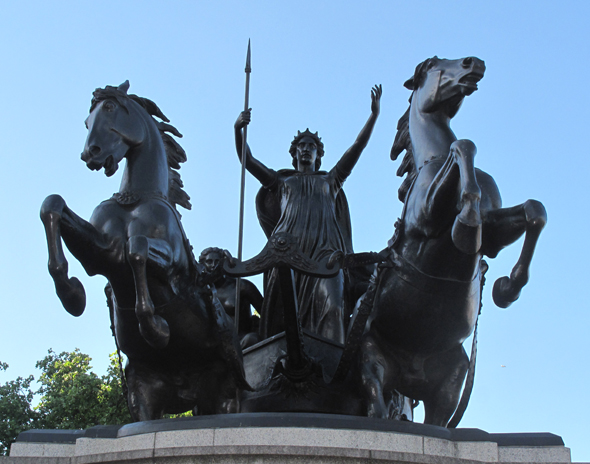
Statue of Boudica in London
But once the rebelling Britons were subdued, it wasn’t long before rebuilding began and Verulamium became one of the province’s wealthiest towns. The mosaics here are distinctive and well preserved with colourful floral and geometric designs. Over forty mosaics dating from AD 150-300 have been found in the villas and town houses unearthed in the area.
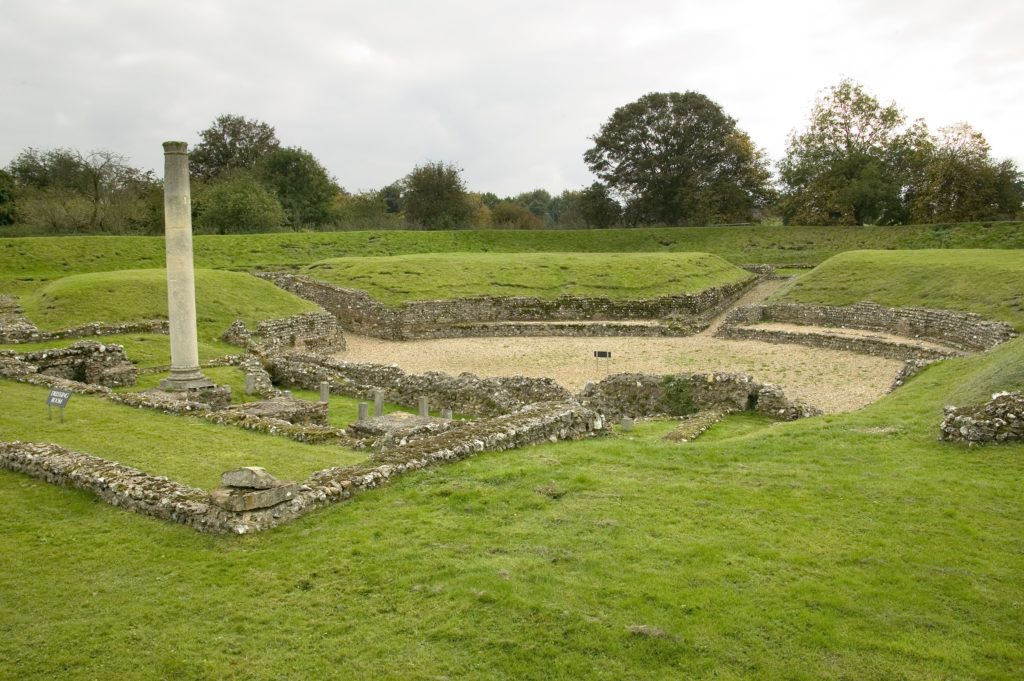
St. Albans theatre, built in AD 140, is unlike most Roman theatres with its round orchestra. It was more like a small amphitheatre and may have been used for gladiatorial games and wild beast shows as well as for dramas and pantomimes.
Roman Theatre at Verulamium
St. Alban was Britain’s first Christian martyr. A Roman citizen, he was beheaded in the late third century AD in Verulamium. The site of his execution became a pilgrimage destination and a Saxon monastery was built in AD 793. The present day abbey is a 19th century restoration of a Norman abbey built in AD 1077.
Like many of the major museums in Europe, the Louvre has so many treasures that some, like these Roman busts, might escape attention.
You’ve just finished elbowing your way to the front of the crowd to get a glimpse of the smaller-than-you-expected Mona Lisa in a side room. Now you’re wandering down the length of the Italian Painting Gallery jam-packed with Medieval and Renaissance masterpieces. How are you expected to even see the Roman marble busts sitting among short columns in niches along the walls?
But there they are – Hadrian, Trajan and others – in all their glory. How many people actually notice them?
Here are just a few of the busts on display:
HadrianYoung Marcus AureliusFaustina, wife of Marcus AureliusTrajanWoman from the time of Trajan
It is not easy finding the footprints of the Roman city of Lutetia beneath a Paris that is jam-packed with Medieval, Gothic, Renaissance and modern architecture. And with only five days to take in just some of what Paris has to offer, I was short of time to find them. But Fortuna smiled on me and I discovered three main Roman sites within a few blocks of my hotel in the Latin Quarter.
Plan of Roman Lutetia from Crypte Archeologique
Crypte Archeologique du Parvis de Notre Dame: Beneath the cathedral on Île de la Cité lies this museum displaying recent archaeological finds of early Paris, including some of the Roman ramparts. I quickly abandoned the Sunday morning crush of Notre Dame above and was rewarded with a quiet, modern museum and an excellent exhibit below.
Roman Rampart of Lutetia
Thermes de Cluny: Across a small square from the Sorbonne, the walls of the Roman baths survive in the Museum of the Middle Ages, Musée Cluny. They were used as part of the structure housing the Cluny Abbots built in the thirteenth century. There are also statues and mosaics from the baths on display here.
Roman Baths in Musee Cluny
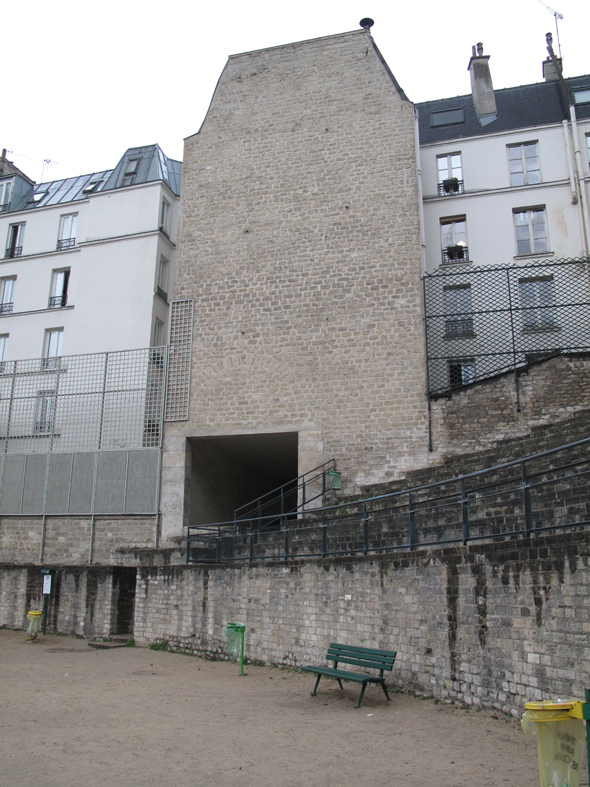
Les Arènes de Lutèce: This amphitheatre dating from the 1st century once held 15,000 spectators. Today it is situated in a park tucked in a side street off Rue Monge and is again a site for entertainment but on a much smaller scale.
Websites store cookies to enhance functionality and personalise your experience. You can manage your preferences, but blocking some cookies may impact site performance and services.
Essential cookies enable basic functions and are necessary for the proper function of the website.
Name
Description
Duration
Cookie Preferences
This cookie is used to store the user's cookie consent preferences.
30 days
These cookies are needed for adding comments on this website.
Name
Description
Duration
comment_author
Used to track the user across multiple sessions.
Session
comment_author_email
Used to track the user across multiple sessions.
Session
comment_author_url
Used to track the user across multiple sessions.
Session
Statistics cookies collect information anonymously. This information helps us understand how visitors use our website.
Google Analytics is a powerful tool that tracks and analyzes website traffic for informed marketing decisions.
Contains information related to marketing campaigns of the user. These are shared with Google AdWords / Google Ads when the Google Ads and Google Analytics accounts are linked together.
90 days
__utma
ID used to identify users and sessions
2 years after last activity
__utmt
Used to monitor number of Google Analytics server requests
10 minutes
__utmb
Used to distinguish new sessions and visits. This cookie is set when the GA.js javascript library is loaded and there is no existing __utmb cookie. The cookie is updated every time data is sent to the Google Analytics server.
30 minutes after last activity
__utmc
Used only with old Urchin versions of Google Analytics and not with GA.js. Was used to distinguish between new sessions and visits at the end of a session.
End of session (browser)
__utmz
Contains information about the traffic source or campaign that directed user to the website. The cookie is set when the GA.js javascript is loaded and updated when data is sent to the Google Anaytics server
6 months after last activity
__utmv
Contains custom information set by the web developer via the _setCustomVar method in Google Analytics. This cookie is updated every time new data is sent to the Google Analytics server.
2 years after last activity
__utmx
Used to determine whether a user is included in an A / B or Multivariate test.
18 months
_ga
ID used to identify users
2 years
_gali
Used by Google Analytics to determine which links on a page are being clicked
30 seconds
_ga_
ID used to identify users
2 years
_gid
ID used to identify users for 24 hours after last activity
24 hours
_gat
Used to monitor number of Google Analytics server requests when using Google Tag Manager