Three thousand years of Roman history in nine days? Well, I did my best. Someone I met traveling once said you must leave something to return to see someday. I have left a few stones unturned in Rome. But this post is about the stones I did turn over and here is some of what I found under them.
Day One
Trajan’s Forum and Column – Trajan’s column tells the story of the conquest of Dacia in pictures. I saw a copy in the Victoria and Albert Museum in London (and wrote a post about it no-tv-no-internet-trajan-had-an-app-for-that) but it’s amazing to see the real thing.
Across the street from Trajan’s Column is the Victor Emanuele Monument, a massive gleaming white landmark that serves well for navigating me back to my nearby hotel as I wander Rome. It celebrates the modern (re-)unification of Italy.
Victor Emanuele Monument
Down the street is the icon of Rome, the Colosseum. Or to be more historically accurate the Flavian Amphitheatre. Its most photographed side is covered with scaffolding so I took a photo from its other side.
No caption necessary – is there?
These were the things I found on my first day in Rome. After traveling for 24 hours to get here, I needed rest for the next 8 days. Much more to come.
After more than thirty years since my last visit, I am returning to Roma (the mother foot?). Back then I knew so little about Roman history, but it was the sights I saw there that fuelled my desire to study ancient history.
In those days of film and photo developing, you couldn’t be quite as shutter happy as you can now with digital cameras. And you never really knew what photos would or wouldn’t turn out until you were long gone. I was in awe of the Pantheon yet I don’t have a picture of it. Was it because I didn’t take one or because it didn’t turn out? I don’t remember but I am looking forward to seeing it again.
The ancient statue of the Laocoon in the Vatican Museums caught my eye, despite not knowing at the time that it was ancient and a representation of a scene from the Trojan War. It was Laocoon who warned about Greeks bearing gifts. Unheeded he was rewarded with death by serpents for him and his sons.
Laocoon in the Vatican Museum
I am excited to return to Rome with more knowledge of her history and culture. And it’s time to update the photo album.
Here are a few more old photos I took in Rome:
Interior of the ColosseumRoman ForumHadrian’s Villa
Traveling in search of Roman sites sometimes takes me off the beaten track. But in Britain, no matter how far off the beaten track one gets, there is always a pub there.
Not only did I happen upon the spot where a bronze head of Emperor Claudius was found in Rendham, Suffolk but I also discovered the White Horse. I visited twice – once for a quick pint and back again for dinner a few weeks later. The food was great!
White Horse Pub in Rendham
Also in Suffolk, I went to Bury St. Edmunds and had a pint in the smallest pub in Britain (in Guiness Book of Records), the Nutshell.
The Nutshell in Bury St. Edmunds
Norfolk – Visiting the Roman forts of Burgh Castle and Caistor-on-Sea led me astray into the Norfolk Broads and to a delightful afternoon stop watching pleasure boats docking at the Ferry Inn in Stokesby.
Boats on the Norfolk Broads
Poking around London for evidence of Romans is best done in museums. After a visit to the British Museum, chock full of Roman artifacts, I nipped into the Museum Tavern across the street. And after a morning at the Museum of London and an afternoon discovering bits of Roman wall and finding the temple of Mithras (when it was still there to find), I had supper at the Old Bell Pub in Fleet Street.
Further west in Hampshire, lunch was needed after a visit to Silchester Roman Town and the Red Lion Pub in Mortimer West End supplied a venison and cranberry baguette along with some local ale.
Lunch at the Rose and Thistle in Rockbourne, near Rockbourne Roman villa, was a smoked salmon sandwich accompanied by a gin and tonic.
The Rose and Thistle, Rockbourne
Over in the Cotswolds, I visited Chedworth Roman villa and the Corinium Museum in Cirencester. In the evening a trip along the old Roman road, the Fosse Way, took me to the Inn at Fossebridge.Inn at Fossebridge, Cotswolds
The little Welsh town of Caerwent is surrounded by high Roman walls and interspersed among the modern houses are the remains of the Roman town of Venta Silurum. At the north gate is, naturally, the Northgate Inn where I stopped for a pint. Is it me, or does that Roman legionnaire look a little fuzzy?
A belated nod to International Men’s Day (November 19) and a salute to Movember — a post about the mystery cult of Mithras. Its rituals were conducted in man-caves, included wing-men and were for men only!
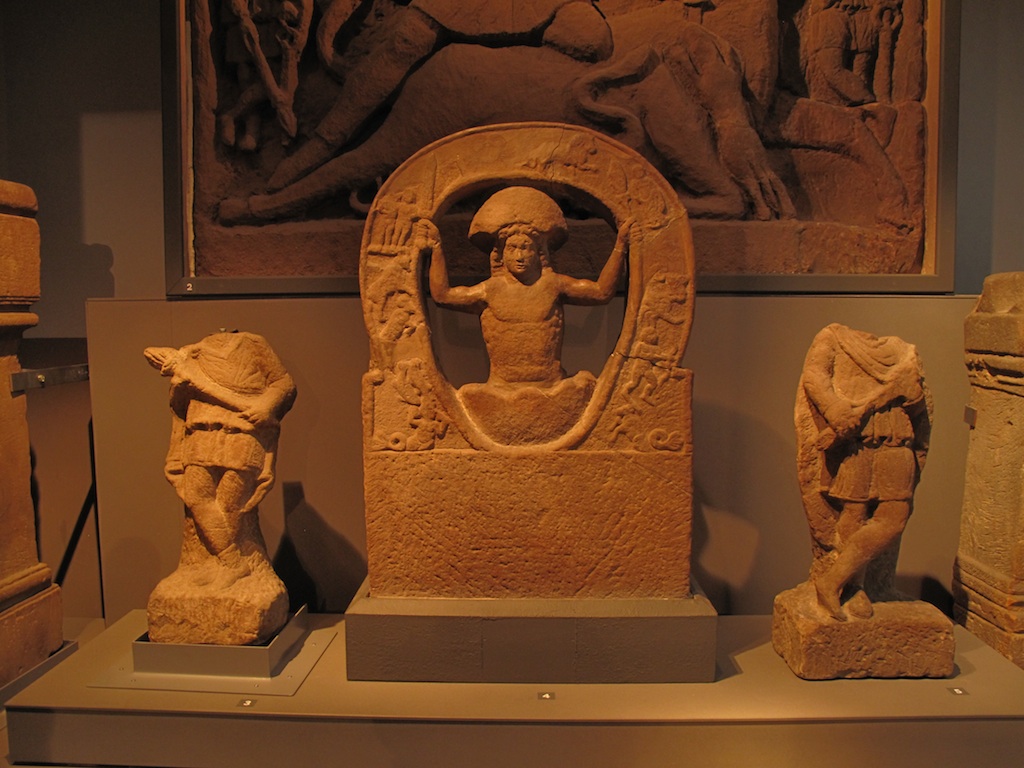
The cult of Mithras began in Persia and became popular among both soldiers and officers of the Roman army. According to legend Mithras was a sun god from heaven. Some traditions have him born from the living rock and others say he came from the Cosmic Egg.
Mithras in Cosmic Egg found at Housesteads, Great North Museum Newcastle
Mithras is said to have slayed the first creature on earth, a bull, and from its blood all life flowed. His temples were designed to resemble caves with a statue or relief of the scene of Mithras killing the bull (the scene is called the tauroctony) at the far end of the temple behind the altars. His companions, Cautes and Catopautes, stood at the entrance of the inner sanctum of the temples.
Tauroctony Relief from Housesteads, Great North Museum Newcastle
On this vivid relief, notice the snake and the dog lapping up the bull’s blood, and hidden behind the cosmic egg, a scorpion pinches the bull’s testicles. Strange and mysterious imagery.
With many soldiers from around the Roman Empire posted to Britannia from AD 43 to AD 410, several temples have been found along Hadrian’s Wall. One at Housesteads (Vercovicium), one at Rudchester (Vindobala) and one at Carrawburgh (Procolita). The last is the best preserved and open for viewing.
Carrawburgh Mithras Temple
I also visited remains of a Mithraeum in London in 2011. It has since been moved and is not on display at present.
When Romans invaded they brought their gods with them but these rarely displaced the local gods. What happened was people would equate local gods with Roman gods. It might have gone something like “oh, Maponus has the same attributes and sphere of influence as Apollo so they must be the same god but with different names.” Dedications have been found to Apollo-Maponus in northern Britain and Gaul, as well as to Mars-Cocidius near Hadrian’s Wall, to Sulis-Minerva at Bath and other similar hybrids.
In Britain, temple remains found are often those of little Romano-Celtic structures. They were fusion temples for fusion gods.
Romano-Celtic Temple at Caerwent, Wales
The temple foundations at Caerwent include a little apse on one end, a common feature of Romano-Celtic temples. A dedication to the god Mars-Ocelus was found here.
Maiden Castle Roman Temple
Romano-Celtic temples were often built in the groves and on the hilltops sacred to Iron Age Celts. They could be square, rectangular or circular with a main room or cella, and surrounded by a covered ambulatory or walkway. This is true of the Roman-era temple atop Maiden Castle Iron Age hillfort in Dorset built in the late 4th century. A bronze plaque with Minerva depicted on it was found here.
Jordan Hill Roman Temple
All that remains of the 4th century temple at Jordan Hill near Weymouth, Dorset is the square outline of the stone foundation walls. What can’t be seen at the site is a 13-foot deep shaft in the centre of the temple that archaeologists found. It held sixteen layers of ash and charcoal alternated with roof slabs and the bones of a bird and a small coin in each layer. At the bottom was a stone cistern with two urns, a sword and a spearhead. This type of feature is believed to have been common to prehistoric Celtic religious sites.
Benwell Roman Temple
Benwell Roman Temple near Newcastle is dedicated to Atenociticus who is thought to have been a local god. Two cement copies of altars that were found during excavation of the temple bear these inscriptions:
To the god Antenociticus and to the Deities of the emperors, Aelius Vibius, centurion of the 20th Legion Valeria Victrix, willingly and deservedly fulfilled his vow.
To the Antenociticus, Tineius Longus (set this up) having, while prefect of cavalry, been adorned with the (senatorial) broad strip and designated quaestor by the decrees of our best and greatest Emperors, under Ulpius Marcellus, consular governor.
In Roman religion people entered into a contract with a god – “if you do this for me, then I will do this for you”. The altars and dedications found at the temples are fulfillments of this type of vow.
Classical Roman temples were known in Britain but little of these has survived. One, the temple of Claudius in Colchester destroyed by Boudica in the 1st century, was massive by all accounts. Its foundations were used as a platform for the largest Norman Keep in Britain.
Colchester Castle built over the Temple of Claudius
There are probably one or two jokes I could make about this title, but I will leave you to your own imaginations instead. I am sure that women might have a different take on it than men. Interpretations are in the eye of the beholder.
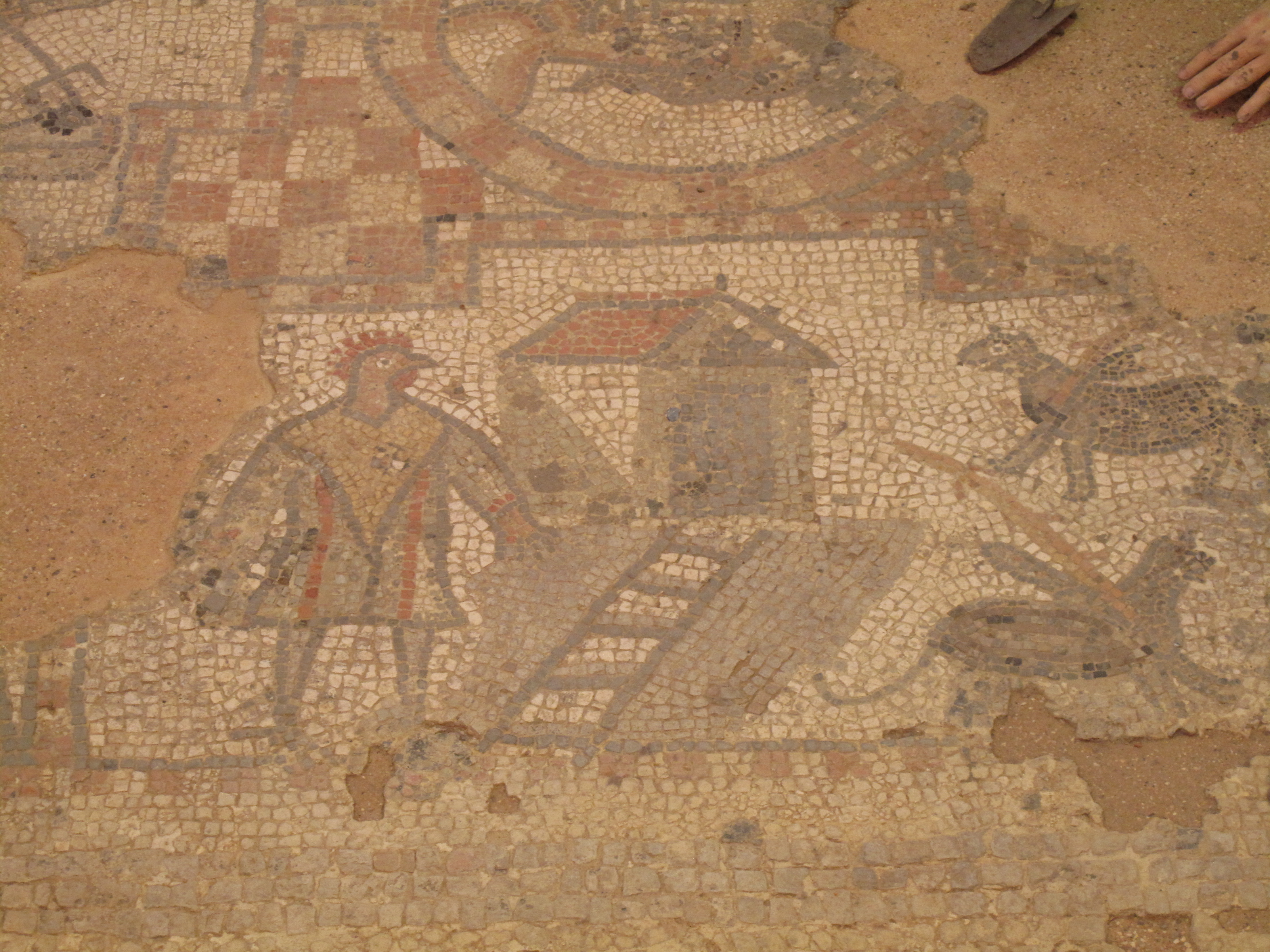
The Cockheaded Man
So who or what was this cockheaded man on a mosaic in Brading Roman Villa on the Isle of Wight? There are no other images quite like it in extant Roman mosaics, so no one really knows quite to make of it.
The signs at Brading suggest the mosaic might have been a satire of the mid-third century emperor, Trebonianus Gallus, gallus being Latin for cockerel. The image is rather cartoon-like and Gallus was unpopular and apparently skewed outcomes of arena games to lead to more deaths than usual. In the mosaic he is dressed up as a gladiator trainer or animal hunter from the arena.
Taking a more serious approach, Martin Henig, in Religion in Roman Britain, identifies the cockheaded man as the god, Iao/Abraxis, and the scene as depicting an allegory on taking a straight and narrow path to heaven.
My own inclination is to go with the satirical interpretation. Yes, Iao was represented in iconography as having a chicken head but he also had snaky legs, which this man does not. This video shows a discussion about the mosaic by experts from the UK Open University who came to the same conclusion.
Serious god or political satire? What is your interpretation?
Find out more about Brading Roman Villa – Quick Facts
Websites store cookies to enhance functionality and personalise your experience. You can manage your preferences, but blocking some cookies may impact site performance and services.
Essential cookies enable basic functions and are necessary for the proper function of the website.
Name
Description
Duration
Cookie Preferences
This cookie is used to store the user's cookie consent preferences.
30 days
These cookies are needed for adding comments on this website.
Name
Description
Duration
comment_author
Used to track the user across multiple sessions.
Session
comment_author_email
Used to track the user across multiple sessions.
Session
comment_author_url
Used to track the user across multiple sessions.
Session
Statistics cookies collect information anonymously. This information helps us understand how visitors use our website.
Google Analytics is a powerful tool that tracks and analyzes website traffic for informed marketing decisions.
Contains information related to marketing campaigns of the user. These are shared with Google AdWords / Google Ads when the Google Ads and Google Analytics accounts are linked together.
90 days
__utma
ID used to identify users and sessions
2 years after last activity
__utmt
Used to monitor number of Google Analytics server requests
10 minutes
__utmb
Used to distinguish new sessions and visits. This cookie is set when the GA.js javascript library is loaded and there is no existing __utmb cookie. The cookie is updated every time data is sent to the Google Analytics server.
30 minutes after last activity
__utmc
Used only with old Urchin versions of Google Analytics and not with GA.js. Was used to distinguish between new sessions and visits at the end of a session.
End of session (browser)
__utmz
Contains information about the traffic source or campaign that directed user to the website. The cookie is set when the GA.js javascript is loaded and updated when data is sent to the Google Anaytics server
6 months after last activity
__utmv
Contains custom information set by the web developer via the _setCustomVar method in Google Analytics. This cookie is updated every time new data is sent to the Google Analytics server.
2 years after last activity
__utmx
Used to determine whether a user is included in an A / B or Multivariate test.
18 months
_ga
ID used to identify users
2 years
_gali
Used by Google Analytics to determine which links on a page are being clicked
30 seconds
_ga_
ID used to identify users
2 years
_gid
ID used to identify users for 24 hours after last activity
24 hours
_gat
Used to monitor number of Google Analytics server requests when using Google Tag Manager