It’s been a week since we finished hiking Hadrian’s Wall Path, ending up at Wallsend near Newcastle. It was a challenging experience – some of the crags were very steep and the weather was at times very cold, wet and windy.
At Wallsend – I did it!
We took eight days to complete the 84 mile/135 kilometre hike and I wouldn’t have wanted to do it any faster. The first two days I had a sore left foot and a pain in my right leg, slowing me down. Fortunately by the third day I was back up to speed, which mind you still put me at the back of the pack. We had some keeners who were always out front.
The Group Stretches Out
Though some of our group had bad blisters or lost toenails, and a couple had to visit a doctor for treatment, everyone completed the hike. What a great group!
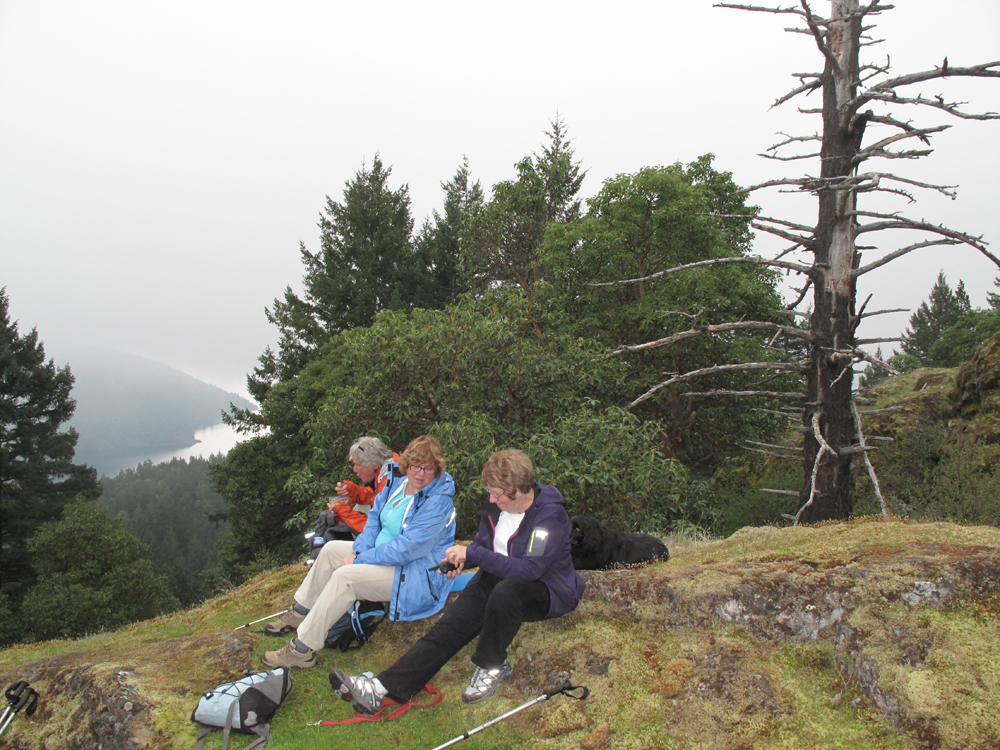
Lunch in a Turret
By walking the entire wall, I was able to see all the bits high on the crags which I hadn’t seen before. But it was a bit of a juggle trying to coordinate the amount of walking we had to do with visits to museums and forts along the way. I did manage to see most everything I wanted, including the new exhibit at the Tullie House Museum in Carlisle, the new 3D film at Roman Army Museum, and the renovations at the Chesterholm Museum at Vindolanda, although I had to hurry there because I only had an hour.
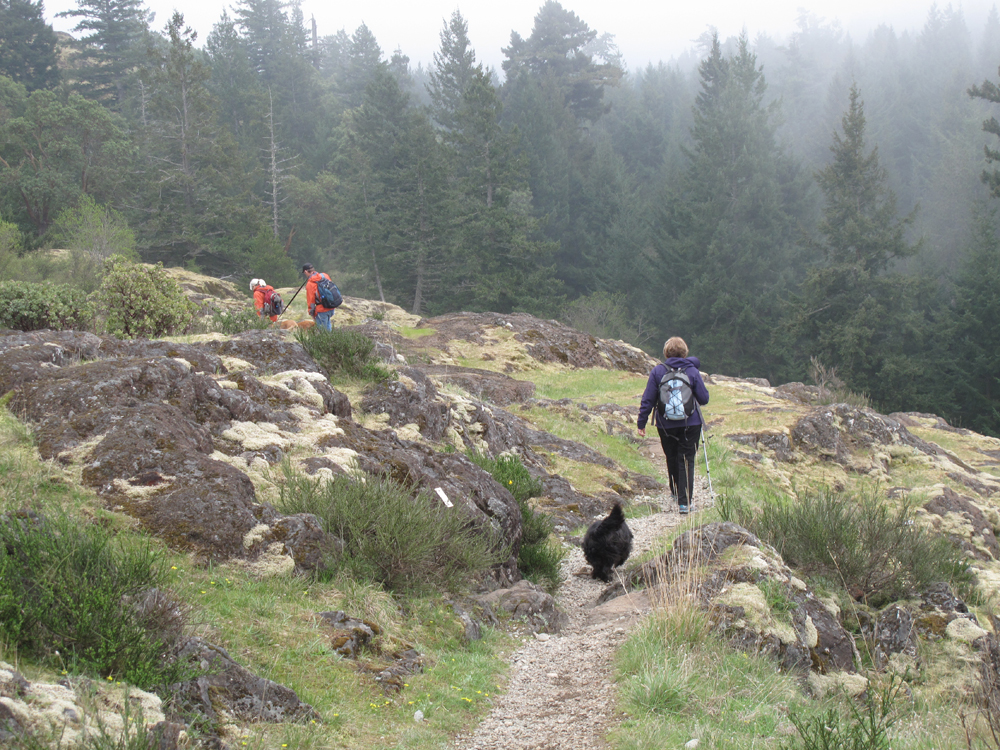
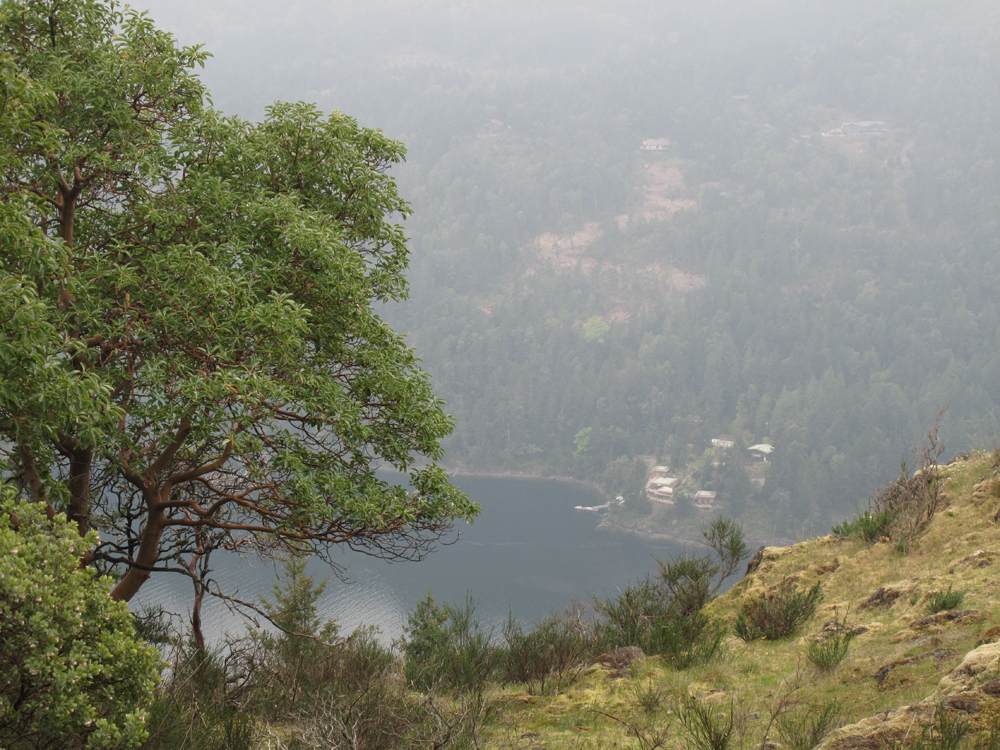
For our last Hadrian’s Wall training hike this past Sunday, April 29th, we hiked the Gowlland-Tod Park trails high above the Saanich Inlet on Vancouver Island. We’re now all heading off in different directions and will meet again in a couple of weeks for our eight day walk along Hadrian’s Wall in northern England.
Hiking in the Mist
The trail was more rugged than Hadrian’s Wall Path will be but the misty views were worth it. And because we hiked around 12 kilometers, I qualified for the Automattic Worldwide Word Press 5k.
Last Saturday night my Hadrian’s Wall hiking group got together for a Roman feast potluck. We dined well on dishes based on ancient Roman recipes adapted in the book, The Classical Cookbook by Andrew Dalby and Sally Grainger. Our menu included:
Honeyed White Wine
Garlic Cheese with Bread
Olives
Parthian Chicken
Shoulder of Pork with Sweet Wine Cakes
Barley with Figs
Tomato and Cucumber Salad
Patina of Nuts
Pineapple Upsidedown Cake with Cream (not Roman but very good)
Figs and Dates
We began our dinner by mingling over the Honeyed Wine aperitif, which was sweet, peppery and surprisingly very good, followed by the very, very garlicky and very popular Garlic Cheese.
The Shoulder of Pork with Sweet Wine Cakes recipe included a barley and fig side dish which was also a surprise hit. When discussing our experience with the recipes, we decided honey and wine were prominent ingredients in most of them. Fortunately there weren’t too many ingredients we couldn’t source, although I failed to get any rue for my red wine sauce so I am not sure how it was really meant to taste.
Not having the space for dining couches nor the slaves to serve the dishes, we dined as poorer Romans might by sitting on chairs and stools. Nor were there any dancing girls for after dinner entertainment but I did my best to bore (I mean amuse) my guests with a slideshow lecture on Roman life along Hadrian’s Wall.
In honour of International Woman’s Day, here are a few women I’ve discovered while exploring Roman footprints in Britannia.
Boudica
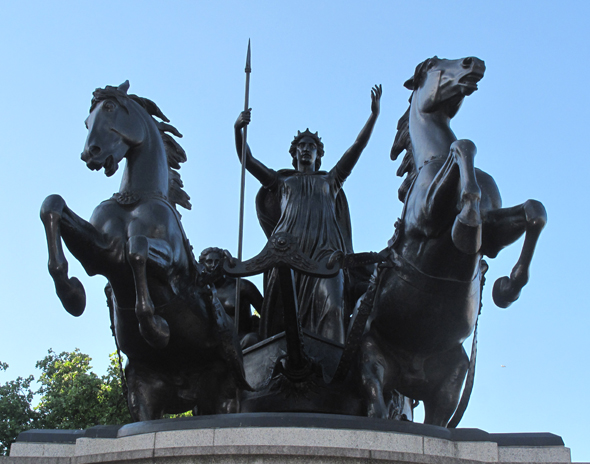
The most famous, or infamous, woman from Roman Britain is Boudica, the Iceni warrior who led an army of native Britons on a rampage in AD 61, destroying the Roman towns of Camulodunum (Colchester) and Verulamium (St. Alban’s) before being stopped by the Roman army. Her story was written, from the Roman perspective, by the writer Tacitus.
Statue of Boudica in London
But there are others, not so famous, whose names have come down to us through inscriptions and other writings which give us little glimpses into their lives.
Claudia Severa and Sulpicia Lepidina
The Vindolanda wooden writing tablets were first unearthed in 1973, having survived in the anaerobic soil at this fort site near Hadrian’s Wall. They reveal correspondence from Claudia Severa to Sulpicia Lepidina. Claudia lived at a fort called Briga on the northern frontier of Britannia probably not far from Vindolanda. Her husband, Aelius Brocchus, was the prefect there. It is easy to imagine her loneliness in a place populated with hostile native tribes, soldiers, slaves, merchants and very few women of her own kind whom she could befriend. But she found a friend in Sulpicia Lepidina, the wife of the Flavius Cerialis, prefect of Vindolanda from the late first to the early second century AD.
Her letters include arrangements for a visit and a birthday party invitation. You can read the tablets (291 and 292) at http://vindolanda.csad.ox.ac.uk/
Regina of the Catuvellauni
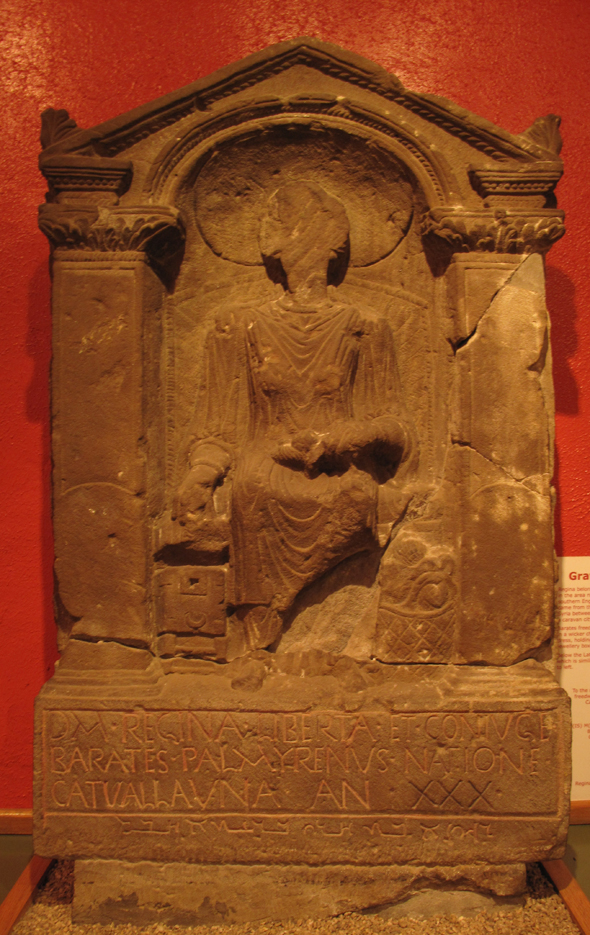
At Arbeia Roman Fort, located in South Shields near Newcastle, we discover Regina through a gravestone erected by her husband, Barates who had come from Palmyra (Syria) and had owned her as a slave before he freed her and married her. She belonged to the Catuvellauni tribe from southern England. She is shown sitting in a wicker chair wearing a fashionable Romano-British dress, holding her spinning on her lap and opening her jewelry box. Below the Latin is a line of Palmyrene text in Aramaic.
This is the translation of her tombstone:
To the spirits of the departed (and) of Regina, freedwoman and wife of Barates of Palmyra, Catuvellauni by birth, died aged 30.
In Palmyrene the inscription says: Regina, the freedwoman of Barates, alas.
Funerary Stele of Regina
Hermione, Daughter of Quintus
This inscription comes from Maryport on the western coast of Cumbria. Below the translation is her story from the interpretive sign at the Senhouse Roman Museum.
To Imperial Virtue … Hermione, daughter of Quintus, gladly, willingly, and deservedly fulfilled her vow.
“Hermione was a freeborn citizen of Greek extraction who, at the time she dedicated two large altars, was probably not married. Her choice of gods for veneration, Imperial Virtue and Juno, wife of Jupiter, shows that she followed mainstream Roman religion. Hermione was unusual, but not unique, in having enough money to commission two expensive altars, and in dedicating them without involving any of the men of her family. Usually, women relied on the head of their family for public demonstrations of faith.
It might be expected that Juno, who oversaw the lives of women and offered protection during marriage and childbirth, would have been a popular choice with the women of the province. However, the Maryport altar is the only one found so far in Britain which is dedicated to Juno by a woman.”
I’ve always wondered where some of the names of Roman Roads in Britain came from; they’re obviously not Latin – Watling Street, Dere Street, the Stanegate, etc. Today I was doing some research and found an answer in the book, Roman Roads in Britain by Hugh Davies.
We don’t actually know what the Romans called their roads in Britain but the names we do have derive from the Anglo-Saxon and Norse invaders who came after the Romans. Watling Street evolved over the centuries to its present form from the Anglo-Saxon Waclinga straete, meaning road leading to the Waclinga tribe. The Stanegate near Hadrian’s Wall comes from stane meaning stone and gate, the Norse for road, so it was known as the stone road.
The section of Roman road on the Wheeldale Moor in North Yorkshire that I visited in late 2010 is part of Wade’s Causeway that travels from Whitby on the east coast. Its name may come from a Norse legend about the sea giant, Wada or Wade. The sign at the site tells us that “he is said to have built the road for his wife, Bell, to herd her sheep along the way to moorland pastures.”
Some of Bell’s Sheep on the North York Moors?
We certainly saw a lot of sheep on the moors that day, perhaps they were some of hers.
Fording the modern road on Wheeldale Moor
We also forded several streams going through the desolate, heather-covered moors. There is always lots of adventure and great scenery to discover along ancient Roman roads.
Creating a slideshow on the Roman fort sites along Hadrian’s Wall this past weekend for the group that is hiking the wall in the spring started me wondering which site or sites I would choose as must-see and which ones I would pass by if I didn’t have the time.
Number one to see has to be Vindolanda. The artefacts in the Chesterholm Museum alone are worth the visit. And I haven’t been there since they updated the museum in 2011, so I think it might even be better now.
Replica Milestone at Vindolanda
Number two would be Chesters with its interesting museum and diversity of remains including the extensive bath house ruins.
Which sites could I go by without seeing again if I didn’t have the time? Probably Birdoswald, because it has the fewest ruins and the best parts of the wall there are outside the site.
And if time was tight in Newcastle, I might choose the Roman exhibit at the Great North Museum over Segedunum Roman fort.
Luckily for our group hiking along Hadrian’s Wall, the wall itself and its setting are the biggest attractions, especially between Walltown Crags and Housesteads Fort, and there will be no missing them.
Websites store cookies to enhance functionality and personalise your experience. You can manage your preferences, but blocking some cookies may impact site performance and services.
Essential cookies enable basic functions and are necessary for the proper function of the website.
Name
Description
Duration
Cookie Preferences
This cookie is used to store the user's cookie consent preferences.
30 days
These cookies are needed for adding comments on this website.
Name
Description
Duration
comment_author
Used to track the user across multiple sessions.
Session
comment_author_email
Used to track the user across multiple sessions.
Session
comment_author_url
Used to track the user across multiple sessions.
Session
Statistics cookies collect information anonymously. This information helps us understand how visitors use our website.
Google Analytics is a powerful tool that tracks and analyzes website traffic for informed marketing decisions.
Contains information related to marketing campaigns of the user. These are shared with Google AdWords / Google Ads when the Google Ads and Google Analytics accounts are linked together.
90 days
__utma
ID used to identify users and sessions
2 years after last activity
__utmt
Used to monitor number of Google Analytics server requests
10 minutes
__utmb
Used to distinguish new sessions and visits. This cookie is set when the GA.js javascript library is loaded and there is no existing __utmb cookie. The cookie is updated every time data is sent to the Google Analytics server.
30 minutes after last activity
__utmc
Used only with old Urchin versions of Google Analytics and not with GA.js. Was used to distinguish between new sessions and visits at the end of a session.
End of session (browser)
__utmz
Contains information about the traffic source or campaign that directed user to the website. The cookie is set when the GA.js javascript is loaded and updated when data is sent to the Google Anaytics server
6 months after last activity
__utmv
Contains custom information set by the web developer via the _setCustomVar method in Google Analytics. This cookie is updated every time new data is sent to the Google Analytics server.
2 years after last activity
__utmx
Used to determine whether a user is included in an A / B or Multivariate test.
18 months
_ga
ID used to identify users
2 years
_gali
Used by Google Analytics to determine which links on a page are being clicked
30 seconds
_ga_
ID used to identify users
2 years
_gid
ID used to identify users for 24 hours after last activity
24 hours
_gat
Used to monitor number of Google Analytics server requests when using Google Tag Manager